
Search has moved past blue links, with AI tools now delivering direct answers and summaries.
Today, people find answers through AI visibility tools, AI-powered search and answer systems like ChatGPT, Perplexity, Google AI Overviews, and other generative platforms that read, summarize, cite, and reuse content directly inside AI-generated responses.

This shift has changed how visibility works. It’s no longer enough to optimize content only to rank on Google.
To actually reach people, content also needs to be optimized for AI search to be visible inside AI-generated answers, often before a user ever clicks a link.
That’s where the best SEO strategies for AI visibility tools come in.
In this guide, I’ll break down the best SEO strategies for AI visibility tools that help content appear inside AI-generated answers from tools like ChatGPT, Gemini, and Perplexity.
Before breaking down the strategies in detail, it helps to see the full picture at a glance in this quick overview below.
TL;DR: Best SEO Strategies for AI Visibility Tools (Quick Overview)
Short on time? The table below summarizes the core SEO strategies for AI visibility tools covered in this guide.
Strategy | What It Means | Why It Matters for AI Visibility |
Optimize for Semantic Understanding | Explain topics and define terms clearly, include entities and show how ideas and topics connect. | This helps AI understand meaning by building topic connections and reuse your content confidently |
Strengthen AI Indexation Signals | Use clear structure, visible authorship, updated content, and schema where relevant | Makes your content easy to process, trust, and safely reuse inside AI answers |
Use Multi-Format Content | Break content into tables, bullets, checklists, FAQs, and short sections | Structured formats are easier for AI (and users) to scan, extract, and cite |
Build Author-Driven Expertise | Show who wrote the content and how they think, not just what they know | AI prefers explanations that feel clearly authored, reasoned, and experience-driven |
Show Trust and Verification Signals | Support claims with screenshots, workflows, comparisons, and real examples | Proof-based content feels safer for AI to trust, reference, and attribute |
Add High-Quality FAQs | Answer common user queries through dedicated question-and-answer sections | FAQs are easy for AI to pull directly into answers and overviews |
Optimize for Action-Ready Content | Write content that clearly shows what to do, in what order, and how | Prepares your content for AI systems that help in executing tasks and workflows, not just explanations |
Each strategy below is explained in detail with examples, reasoning, and practical guidance, so you can apply them deliberately, not mechanically. Click here to jump to this section.
SEO hasn’t disappeared, but it has expanded. Optimizing content today means helping both search engines and AI systems understand, trust, and reuse your content whether it appears as a ranking, a citation, or part of an AI-generated summary.
These strategies reflect how AI systems actually read, evaluate, and reuse content today, and they form the foundation for visibility across tools like ChatGPT, Perplexity, Claude, Google AI Overviews, and similar platforms.
What Is AI Search (And How It’s Different)
AI search refers to systems that retrieve information from multiple sources and generate answers, rather than showing only ranked results.
Unlike traditional search engines, AI systems don’t rely only on keywords or links. They try to understand what a topic means, how ideas connect, and which sources feel reliable enough to reuse.
In practice, this means AI systems:
- interpret meaning rather than exact keywords
- connect ideas across multiple pages
- reuse content snippets directly inside answers
- decide which sources feel safe and trustworthy to reference
Ranking still matters, but being understandable, reusable, and citable now matters just as much. This shift changes not just where content appears, but how it gets discovered and surfaced.
That naturally leads to the next question: what does “visibility” even mean in an AI-driven search world?
What AI Visibility Really Means
AI visibility means your content is clear enough for AI systems to use it, not just index it confidently. When AI systems can interpret your content properly, it becomes eligible to appear as:
- generated answers
- recommendations or comparisons
- citations or source links
- reference icons shown alongside AI summaries
This type of visibility doesn’t always look like a ranking. Instead, it shows up through citations, brand mentions inside AI answers, referral traffic from AI tools, or users discovering your site during AI-driven research.
For many topics, especially learning, comparisons, and early-stage decisions, AI answers and summaries across AI tools are now where discovery begins. Hence, it’s important to optimize your content to make it visible in these AI tools.
That’s why it’s worth discussing the best SEO strategies for AI visibility tools in detail to optimize content for AI search.
Best SEO Strategies for AI Visibility Tools in 2026
A page can perform well in search results and still not appear in AI-generated answers. AI systems don’t automatically reuse the top-ranking page, they favor content that’s clear, well-connected, experience-driven, regularly updated, and easy for them to understand and reuse.
These AI visibility SEO strategies are designed specifically for AI-powered search tools that generate answers, summaries, and citations.
Here are the best practices for AI visibility SEO you need in 2026, based on my experience and learnings:
1. Optimize for Semantic Understanding
Search systems today don’t look for exact keyword matches, they try to understand what your content is actually about and how ideas connect.
Semantic optimization is about writing in a way that makes the main topic, its subtopics, and their relationships obvious to readers and to AI systems.
Behind the scenes, AI uses vector (meaning) based models to recognize when different sentences express the same idea, even if the wording changes.
For example, phrases like:
- “How to build a content strategy”
- “Steps to plan effective content”
- “How to make a content plan from scratch?”
all point to the same concept.
Most content doesn’t fail because of how it’s written, but because ideas aren’t properly connected. To make those connections clear in practice:
- define important terms the first time you use them
- explain how one idea leads to or depends on another
- group closely related points under the same section instead of scattering them
- link internally when two pieces explain parts of the same topic
When you do this, AI doesn’t treat your content as isolated paragraphs. It starts building a clear mental map of the topic, often described as a mini knowledge graph and your page reads like a complete, well-organized explanation instead of a collection of tips.
Why this is important:
AI tools like ChatGPT, Perplexity, and Gemini rely heavily on context. Content that clearly explains meaning and relationships is easier to understand, summarize, and reuse inside AI-generated answers.
2. Strengthen AI Indexation Signals
Once AI understands what your content is about, it evaluates whether the content is easy to process, reliable, and safe to reuse.
AI looks for clear structure and maintenance signals, such as:
- show a visible author bio and a clear last-updated date
- structure content with headings, short paragraphs, bullets, and tables
- answer questions directly instead of burying them in long text
- link to relevant internal content to show topic relationships
When these elements are present, AI can confidently process and reuse the content.
Structured data (schema markup) can further support machine understanding where relevant, for articles, authors, FAQs, or reviews. Schema doesn’t replace good writing or structure, but helps AI interpret content types and relationships more accurately.
For example:
I’ve used a “person” schema for my author page, because it talks about me, a person, and for my blogs, I use an “article/ blogpost” schema.
AI also favors content that behaves like a living document.
Continuously improving content, refining explanations, adding better examples, and updating key sections signals ongoing care. Content that evolves in this manner is considered a safer and more reliable source for reuse than static content.
Even newer sites benefit when content is clearly structured, easy to parse, and visibly maintained.
3. Use Multi-Format Content (Structured for AI Retrieval)
AI systems struggle with long, dense blocks of text, but they work extremely well with structured information.
Breaking content into clear formats like bullet points, tables, and Q&A sections helps ideas come through more clearly for readers and AI systems alike.
This is especially important because many AI systems use Retrieval-Augmented Generation (RAG).
To explain RAG simply, AI scans articles, pages, and documents to find useful parts, and then uses those pieces to construct an answer.
Content that’s clearly organized works better in this process, because it makes it easier for AI to:
- scan quickly
- pull specific facts or steps
- reuse clean sections inside summaries or citations
A simple way to apply this:
For comparisons → use tables
To describe processes → checklists or steps
For definitions → use brief explanations or a glossary-style section
For questions → use FAQ format to answer questions
I use this approach across my blogs. Comparison tables, bullet-based breakdowns, and clear frameworks are core to my writing, including this post.
For example:
In my AI tools comparison articles like 8 Best AI Video Tools and 15 Best AI Image Tools use a side-by-side comparison table with ratings so readers and AI systems can quickly understand differences without reading long explanations.
4. Build Author-Driven Expertise
In AI-driven search, visibility depends not just on what is written, but who is explaining it and how they explain it.
When multiple pages cover the same topic, AI systems implicitly ask:
“Which explanation shows real understanding and ownership?”
Author-driven expertise isn’t about credentials alone. It’s about intellectual ownership, showing that a real person understands why something works, not just what it is.
AI looks for signals like:
- a clearly identifiable author
- explanations that include reasoning and judgment
- clarity around trade-offs, priorities, or common misunderstandings
How to apply this:
Make the author visible
Every blog should clearly show who wrote it. This includes:
- a visible author bio
- a dedicated author page explaining your background and areas of focus
These signals help AI associate your content with a specific person and topic area instead of treating it as anonymous information. I’ve implemented this on my site as well, with an author page and bios at the end of each article.
Write with interpretation, not just execution
AI already knows definitions. What it values more is how you think about a topic.
That means explaining:
- why certain aspects matter more than others
- where people usually get confused
- how ideas connect logically
- when something works and when it doesn’t
Purely generic explanations are easy to replace. Nuance, prioritization, and judgment are not and that’s what makes content reusable for AI systems.
Why this works
AI tools tend to reuse explanations that feel clearly authored, thoughtful, and intentional. Strong author-driven expertise builds trust in the thinking behind the content even before external proof is considered.
5. Show Trust and Verification Signals
Once AI recognizes the author and understands the topic, the next question is: “Can these claims be verified?”
Trust and verification signals show that content is grounded in real work and reliable, not just theory. These signals include:
- screenshots of real examples
- original tables, comparisons, or ratings based on your judgment
- documented workflows or processes
- experiments or test results
- citations to trusted sources when relevant
- shared experiences and insights
These elements serve as evidence that supports your claims and make it obvious where the information comes from and why it can be trusted.
That clarity makes the content easier for both readers and AI to attribute and cite your content.
How I apply this
Below is an image that pulls together snippets from my blogs, showing how I share workflows, insights, ratings, comparisons, prompts, and real screenshots throughout my content.
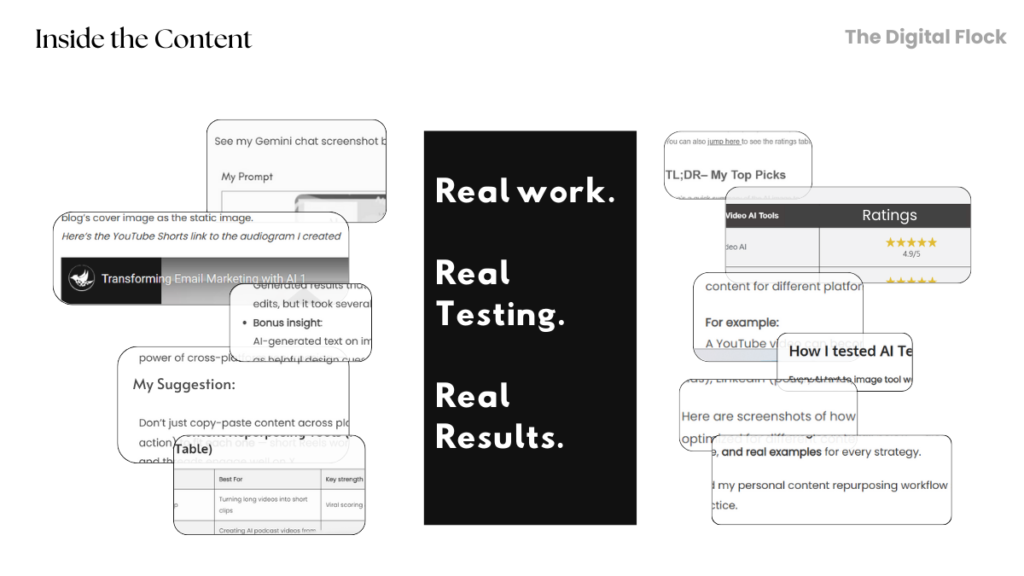
This kind of example-driven content helps both readers and AI systems quickly verify that the information is based on experience. This is one of the most important strategies for artificial intelligence search optimization.
6. Add High-Quality FAQs
FAQs make your content easier for AI to understand and easier for users to trust. Short, direct Q&A blocks help AI:
- identify intent quickly
- extract answers in a clean, structured format
- reuse those answers inside AI Overviews and chat responses
- see your page as a complete, well-explained resource
AI tools love bite-sized information. FAQs make your content into small, ready-to-use facts, which improves visibility as AI can show these answers directly when the relevant question is asked.
A strong FAQ section usually includes 5-12 focused, relevant questions, depending on your content’s depth. You can see my FAQ section at the end of this blog.
How to Choose the Right FAQs (Updated for 2025)
To make FAQs useful for both users and AI, focus only on questions people actively search for. I usually combine signals from a few reliable sources instead of relying on just one:
- Google “People Also Ask”
Repeated questions (even with wording variations) are strong indicators of real user intent. - AI tools (ChatGPT, Perplexity, Gemini)
These surface common follow-up questions users ask, making them useful for identifying FAQ angles. - SEO tools (Semrush, Ahrefs, Ubersuggest)
Question-based long-tail keywords help validate demand. I typically check the “Questions” tab to shortlist relevant queries. - Community platforms
Reddit, Quora, YouTube comments, and forums reveal recurring doubts that often don’t appear in keyword tools. - Competitor pages and content gaps
Top-ranking pages help set expectations, while gaps in your own content can be moved into FAQs to keep the main flow clean.
FAQs covering definitions, steps, comparisons, benefits, risks, and examples are the easiest for AI systems to extract and reuse.
This is one of the best practices for SEO enhancing AI visibility, as these FAQs directly answer questions and have a high chance of being cited.
7. Optimize for Action-Ready Content
This strategy isn’t about how your content sounds, it’s about how usable it is.
AI systems today don’t just answer questions. Many can assist with tasks, follow instructions, and help users complete workflows. That means AI systems don’t just look for explanations; they look for content they can act on.
Action-ready content is written in a way that clearly tells both humans and AI systems what to do, in what order, and under which conditions.
Instead of describing processes in long paragraphs, action-ready content breaks steps down, making them easy to follow and extract. You can achieve this using:
- Step-by-step instructions
- Checklists to define completion
- Workflows showing sequences
- Decision paths explaining “if this, then that”
This makes content practical, actionable, and ready for AI-powered reuse.
Example:
Imagine asking an AI tool:
“Build a content repurposing plan for a blog focused on AI SEO strategies.”
An action-ready AI response could include:
- Identify key sections of the blog (e.g., strategies, tips, examples).
- Recommend content formats for each section like LinkedIn posts, Instagram carousels, short YouTube scripts, Twitter threads.
- Suggest AI tools for each step like ChatGPT to summarize sections, ImagineArt to create visuals, NoteGPT to create podcasts.
- Give practical guidance (e.g., highlight key takeaways, use visuals, write in concise steps).
- Provide a sequenced plan, a clear order of tasks that can be executed immediately without guesswork.
This shows how AI interprets content that’s structured for action, not just explanation. Writing with execution in mind ensures your content isn’t just informative, but truly usable by both readers and AI systems.
To see this strategy in action, check out my article on Content Repurposing Strategies, where I walk through a workflow that turns one blog into content for multiple platforms, complete with AI tools, tips, and generated examples.
These are the best practices for SEO enhancing AI visibility in the era of AI search. But they can feel overwhelming, and it’s easy to wonder where to start.
To make it easier, I’m sharing my personal workflow, showing how to optimize content for AI search engines and apply these AI visibility SEO strategies step by step.
How to Optimize Content for AI Search Engines (My Workflow)
Instead of treating AI SEO as a separate checklist, I see it as part of how I plan, write, and maintain content, essentially showing how to make blog content AI-friendly. This is the exact process I follow when creating a blog post today.
1. I start with the topic and the intent behind it
After finalizing the topic of the content, I get clear on why someone is searching for this topic. I usually ask:
- Are they trying to understand something? (concepts, trends, explanations)
- Do they want suggestions? (strategies, tools, ideas)
- Are they trying to decide? (comparisons, reviews)
- Or do they want to execute something? (steps, workflows, action plans)
This decides the flow of the blog, the sections I include, and how deep I need to go.
2. I outline the blog with readers and AI in mind
Once the intent is clear, I outline the content before writing.
At this stage, I think from two perspectives at the same time:
- Readers: Is the structure easy to follow? Does the main topic appear early, or is it pushed too far down?
- AI systems: Is the content clearly organized so ideas aren’t scattered or buried?
I make sure the core topic shows up early. If users need to scroll too much to understand what the page is about, they often leave which hurts both readability and AI visibility.
3. While writing, I focus on clarity and meaning
When I start writing, clarity is my top priority. I use simple, straightforward language and avoid unnecessary noise.
When content is written naturally, related terms, entities, and semantic keywords usually appear on their own, but I still stay conscious of including important concepts where they actually matter.
4. I deliberately add my personal experience and perspective
This is non-negotiable for me. Almost everything I write includes my own experience, observations, or examples. If I explain a concept, I also explain:
- how I applied it,
- what I noticed,
- what worked or didn’t,
- or how my thinking evolved.
I write in the first person (“I’ve found…”, “What I noticed…”, “In my experience…”) and often support points with screenshots, examples, or visuals.
Once you add your own thinking, content stops feeling generic and becomes far more effective for both humans and AI.
5. I structure content as I write, not afterward
While writing, I actively structure content using bullet points, tables, short paragraphs, question–answer formats, and visuals where helpful. This makes the content easier to scan, understand, and extract from.
6. I strengthen context, trust, and ownership
While writing, I’m mindful of credibility signals.
When I reference external information, I link only to trusted sources. I also internally link related articles to show topical depth and context. Along with this, I make authorship visible through a clear author bio and a dedicated author page.
This combination helps establish trust, ownership, and topical authority across the site.
7. Add TL;DRs and FAQs for quick understanding
For longer sections, I include TL;DR summaries so readers can grasp the key points quickly. I sometimes use AI tools like ChatGPT to generate these, based only on my original content.
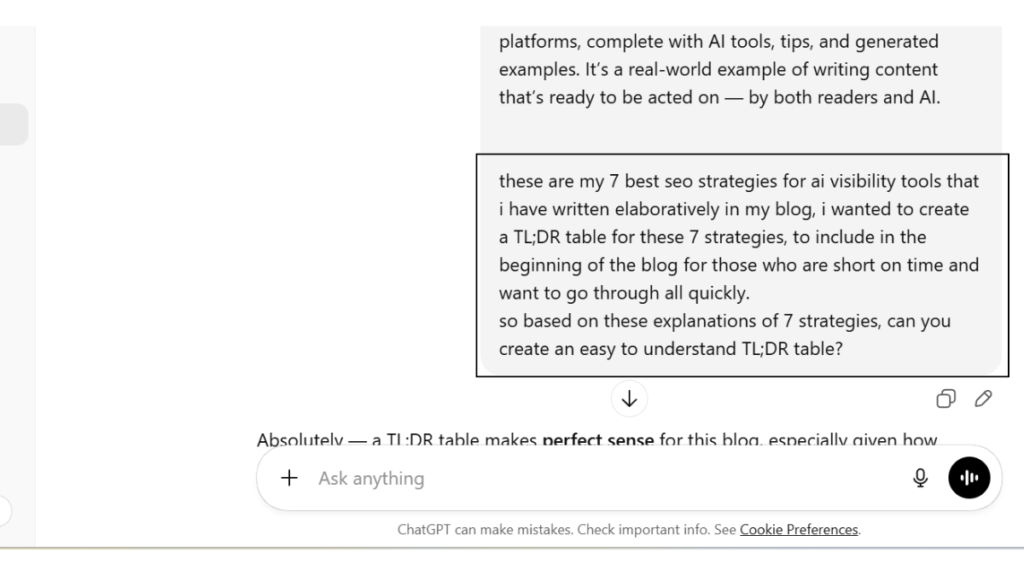
To be completely transparent with you, I am sharing a screenshot of my prompt on ChatGPT where you can see how I’ve asked it to create a TL;DR table for me based on the 7 strategies I’ve written in depth.
I simply pasted my detailed strategies section and then asked it to create a TL;DR table based on them:
I use FAQs to answer likely reader questions, clarify doubts, and include useful details that didn’t fit naturally into the main flow.
8. I update content after publishing
I regularly update posts by adding new insights, improving internal links, expanding FAQs, or refining explanations based on experience.
Not updating content wastes the effort already invested, content that evolves stays useful and visible for longer.
Up until now, I’ve focused on what to do and how I personally apply these strategies. To understand why this approach works and why it’s becoming increasingly important, it helps to step back and look at how search itself is evolving.
From SEO to AI Search Optimization
Earlier, SEO was mostly about getting pages to rank using the right keywords, building links, and making sure search engines could read your site. Those things still matter.
But search has changed. Today, your content isn’t only read by search engines. AI tools also look at it and try to understand what it’s really saying, just like a person would when reading an article.
Because of this shift, a newer approach has started to matter, often called Artificial intelligence search optimization (you might also see it called AI SEO or AEO).
It doesn’t replace what we already know about SEO. It simply adds a new layer to how content needs to be written and organized. For example, to be visible, your content should now have:
- clarity of meaning
- structure that machines can easily extract
- visible authorship and trust
- content that feels safe to reuse
Search platforms are now deeply influenced by AI. For example, Google uses AI to better grasp topics and display AI-generated summaries directly in search results.
At the same time, tools like ChatGPT and Perplexity usually present a clear answer first, and then reference information from different websites.
Because of this change, content today needs to function in two ways at once:
- search engines that rank pages
- AI systems that interpret and reuse them
Both still value clear writing, proper context, and good structure. However, AI expects ideas to be explained in an even more straightforward and well-connected way.
This shift is why artificial intelligence search optimization and learning how to optimize for AI search engines has become essential for modern content creators, and it needs its own thoughtful strategy.
Now that you’ve seen the best practices for AI visibility SEO that I shared and my full workflow sharing how to optimize for AI search engines, let’s wrap up and summarize what really matters for AI-visible content.
Wrapping Up
AI-powered search has changed the game; it’s not enough to just rank anymore. Artificial intelligence search optimization has become really important if you want your content to be visible.
Your content needs to be clear, structured, trustworthy, and actionable so AI systems can read, understand, and reuse it.
Following these best SEO strategies for AI visibility tools and my workflow on how to optimize content for AI search engines, I’ve shared everything from understanding intent, writing with clarity and personal insights, structuring content, signaling trust and authorship, to keeping it updated, ensuring your content is ready for both AI and human readers.
In short:
Write with clarity, context, and credibility, and your content will be visible, reusable, and valuable wherever your audience looks from search results to AI-generated answers.
When done correctly, these best SEO strategies for AI visibility tools help ensure your content is discoverable, citable, and reusable across AI-powered search platforms.
Frequently Asked Questions (FAQs):
About the Author

AI marketing strategist & founder of The Digital Flock, specializing in AI tools, AI SEO, and content automation. She applies AI in real marketing workflows and documents the results through strategies, tutorials, and case studies to help marketers use AI practically.